
 Share
Share

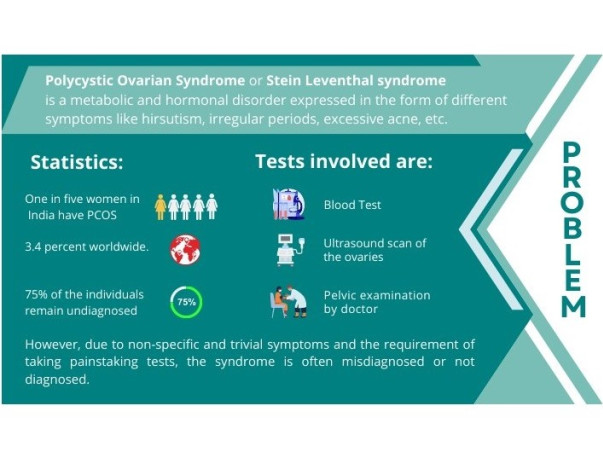
We are a group of 15 undergraduate students from the Indian Institute of Science Education and Research, Tirupati, India. We are participating in an international synthetic biology competition organised by International Genetically Engineered Machine (iGEM) annually. This year, our team is working towards ‘AptaSteles,’ a novel diagnostic kit for Polycystic Ovarian Syndrome (PCOS). Also known as Stein Leventhal syndrome, PCOS is a metabolic and hormonal syndrome. It is expressed as symptoms like irregular periods, male-patterned hair growth, and obesity, to name a few. One in five women in India suffers from PCOS. Around 3.4% of women have PCOS globally. Diagnosis of this syndrome is based on results of a blood test, sonogram of the ovaries, and pelvic examinations by doctors. However, due to the non-specific and trivial symptoms, the disease is either not diagnosed or misdiagnosed. Nearly 75% of the patients with PCOS are undiagnosed. Studies show that untreated PCOS may lead to insulin resistance, cardiovascular disorders, infertility, and different types of cancers in extreme cases.
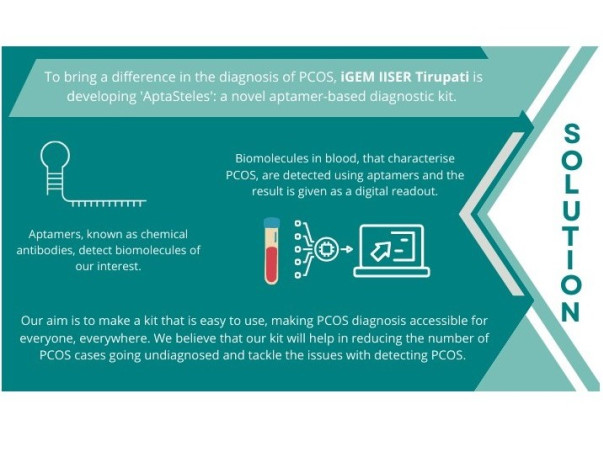
For a treatment to begin, early diagnosis is a prerequisite. To tackle the issues of diagnosis, our team aims to develop a diagnostic kit for PCOS which detects it on the basis of biomolecules, referred to as biomarkers, that fluctuate in cases of disorders. We are detecting an array of biomarkers in a concentration-dependent manner by aptamers. Aptamers are short stretch oligonucleotides or peptides that can form certain secondary structures that could bind to specific molecules and give output in different forms. The aptamers that we use are light-up aptamers that give fluorescence output. Since the concentration of the biomarkers is very low in the blood, we are incorporating amplification techniques that could increase the intensity of the signal these aptamers give. These are included in hardware based on the principles of microfluidics and other optical sensing mechanisms. Our goal is to bring out a kit that makes PCOS detection accessible for everyone, everywhere. In this way, we are tackling the complications involved in the diagnosis of PCOS.
For a treatment to begin, early diagnosis is a prerequisite. To tackle the issues of diagnosis, our team aims to develop a diagnostic kit for PCOS which detects it on the basis of biomolecules, referred to as biomarkers, that fluctuate in cases of disorders. We are detecting an array of biomarkers in a concentration-dependent manner by aptamers. Aptamers are short stretch oligonucleotides or peptides that can form certain secondary structures that could bind to specific molecules and give output in different forms. The aptamers that we use are light-up aptamers that give fluorescence output. Since the concentration of the biomarkers is very low in the blood, we are incorporating amplification techniques that could increase the intensity of the signal these aptamers give. These are included in hardware based on the principles of microfluidics and other optical sensing mechanisms. Our goal is to bring out a kit that makes PCOS detection accessible for everyone, everywhere. In this way, we are tackling the complications involved in the diagnosis of PCOS.