 Share
Taj ke Saat Rang 2026
A Queer Heritage Festival in Agra
Taj ke Saat Rang is an annual queer cultural festival held in Agra during Pride Month, emerging from a simple yet radical question:
Why are monuments of love reserved for only one kind of love?
Rooted in the heritage landscape of Agra and hosted at Kala Kutir, the festival brings together artists, performers, researchers, students, local communities, and queer individuals to collectively reimagine what heritage can mean when viewed through queer lenses.
Agra is globally recognised through the imagery of the Taj Mahal, often framed as the ultimate symbol of romance. Yet, the stories that shape cities are always more layered, more intimate, and more plural than dominant narratives allow. Taj ke Saat Rang attempts to create space for these overlooked and underrepresented histories — particularly queer experiences that have often remained invisible within public memory, cultural discourse, and urban life.
The festival is not simply about “visibility.” It is about presence, belonging, and the creation of liberatory cultural spaces where queer lives can exist without apology.
---
Queering Heritage
One of the core interventions of the festival is what we call “Queering the Monument.”
Through films, performances, walks, photography, and public artistic interventions, queer individuals inhabit heritage spaces across Agra — not as spectacles, but as people existing fully and truthfully within the city.
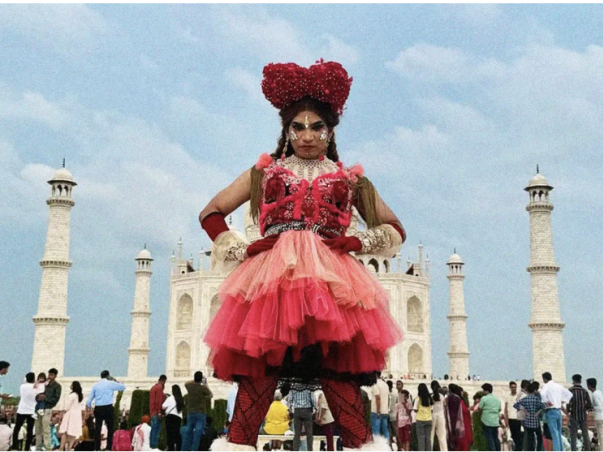
In the previous edition, drag performers entered the visual landscape of the Taj Mahal, creating a powerful yet quiet disruption that asked audiences to reconsider who gets represented within monuments associated with love and cultural memory.
For the 2026 edition, the inquiry deepens further:
What does it mean to be a Desi Queer?
The festival seeks to explore queerness beyond metropolitan frameworks by focusing on experiences emerging from tier-II cities and smaller cultural contexts. These are stories shaped by negotiation — between visibility and discretion, intimacy and social expectation, family and selfhood, tradition and transformation.
---
Space as Queer
Alongside heritage interventions, the festival transforms Kala Kutir into a temporary queer cultural commons.
Across two days, participants gather through:
The previous edition featured a Drag Durbar, queer performances, discussions on queer existence in tier-II cities, heritage walks through Agra, and collective gatherings that brought together participants from different cities and backgrounds.
For many attendees, it was the first time they had experienced a public queer gathering in a city like Agra.
As one participant shared:
> “We could never imagine being part of a festival like this in our lifetime.”
---
Kala Kutir: The Home of the Festival
Taj ke Saat Rang is hosted at Kala Kutir, an artist residency and cultural centre located near the Taj Mahal and being shaped under UNESCO’s Intangible Heritage framework.
Kala Kutir functions as a living cultural space where art, storytelling, heritage, food, music, and community intersect. Over the past year, it has hosted collaborative initiatives including the Agra Art Festival and Taj ke Saat Rang, creating a growing ecosystem for independent cultural practice in Agra.
The space allows the festival to remain intimate, community-oriented, and rooted in dialogue rather than spectacle.
---
Taj ke Saat Rang 2026
The upcoming edition of the festival aims to expand both its artistic and cultural reach.
Planned components include:
The festival also seeks to build a stronger archive of queer cultural expression in non-metropolitan India through documentation, photography, film, and collaborative storytelling.
---
Why This Matters
In many tier-II cities, queer cultural spaces remain limited, fragmented, or inaccessible.
Taj ke Saat Rang attempts to create something different: a space where queer individuals and allies can gather through culture, conversation, celebration, and shared memory.
The festival positions joy itself as a form of resistance.
By reclaiming heritage spaces, amplifying local queer narratives, and building community through art, the festival contributes to a broader cultural conversation about belonging, identity, and the right to exist visibly within public life.
It asks an essential question:
Can heritage belong to everyone?
---
Looking Ahead
What began as an intimate gathering has steadily evolved into a growing cultural platform.
From small community gatherings to larger public participation through associated initiatives like the Agra Art Festival, the ecosystem around Kala Kutir continues to expand.
The long-term vision of Taj ke Saat Rang is to establish Agra not only as a city of monuments, but also as a city of contemporary cultural dialogue, plural histories, and inclusive artistic practice.
Through collaboration, storytelling, and collective imagination, the festival hopes to continue building space for queer existence, memory, and celebration in one of India’s most historically symbolic cities.
A Queer Heritage Festival in Agra
Taj ke Saat Rang is an annual queer cultural festival held in Agra during Pride Month, emerging from a simple yet radical question:
Why are monuments of love reserved for only one kind of love?
Rooted in the heritage landscape of Agra and hosted at Kala Kutir, the festival brings together artists, performers, researchers, students, local communities, and queer individuals to collectively reimagine what heritage can mean when viewed through queer lenses.
Agra is globally recognised through the imagery of the Taj Mahal, often framed as the ultimate symbol of romance. Yet, the stories that shape cities are always more layered, more intimate, and more plural than dominant narratives allow. Taj ke Saat Rang attempts to create space for these overlooked and underrepresented histories — particularly queer experiences that have often remained invisible within public memory, cultural discourse, and urban life.
The festival is not simply about “visibility.” It is about presence, belonging, and the creation of liberatory cultural spaces where queer lives can exist without apology.
---
Queering Heritage
One of the core interventions of the festival is what we call “Queering the Monument.”
Through films, performances, walks, photography, and public artistic interventions, queer individuals inhabit heritage spaces across Agra — not as spectacles, but as people existing fully and truthfully within the city.
In the previous edition, drag performers entered the visual landscape of the Taj Mahal, creating a powerful yet quiet disruption that asked audiences to reconsider who gets represented within monuments associated with love and cultural memory.
For the 2026 edition, the inquiry deepens further:
What does it mean to be a Desi Queer?
The festival seeks to explore queerness beyond metropolitan frameworks by focusing on experiences emerging from tier-II cities and smaller cultural contexts. These are stories shaped by negotiation — between visibility and discretion, intimacy and social expectation, family and selfhood, tradition and transformation.
---
Space as Queer
Alongside heritage interventions, the festival transforms Kala Kutir into a temporary queer cultural commons.
Across two days, participants gather through:
- Performances
- Film screenings
- Heritage walks
- Panel discussions
- Open mics
- Music and dance gatherings
- Shared meals and conversations
The previous edition featured a Drag Durbar, queer performances, discussions on queer existence in tier-II cities, heritage walks through Agra, and collective gatherings that brought together participants from different cities and backgrounds.
For many attendees, it was the first time they had experienced a public queer gathering in a city like Agra.
As one participant shared:
> “We could never imagine being part of a festival like this in our lifetime.”
---
Kala Kutir: The Home of the Festival
Taj ke Saat Rang is hosted at Kala Kutir, an artist residency and cultural centre located near the Taj Mahal and being shaped under UNESCO’s Intangible Heritage framework.
Kala Kutir functions as a living cultural space where art, storytelling, heritage, food, music, and community intersect. Over the past year, it has hosted collaborative initiatives including the Agra Art Festival and Taj ke Saat Rang, creating a growing ecosystem for independent cultural practice in Agra.
The space allows the festival to remain intimate, community-oriented, and rooted in dialogue rather than spectacle.
---
Taj ke Saat Rang 2026
The upcoming edition of the festival aims to expand both its artistic and cultural reach.
Planned components include:
- A new film exploring queer traditional artistic lineages and contemporary queer expression in Agra’s heritage spaces
- Queer heritage walks across lesser-known monuments and hidden urban histories
- Film screenings exploring identity, performance, and embodiment
- Mujra-inspired performance nights reclaiming dance, sensuality, and public expression
- Open mic spaces for poetry, storytelling, and conversation
- Dialogues around queerness, resistance, joy, and solidarity in contemporary India
The festival also seeks to build a stronger archive of queer cultural expression in non-metropolitan India through documentation, photography, film, and collaborative storytelling.
---
Why This Matters
In many tier-II cities, queer cultural spaces remain limited, fragmented, or inaccessible.
Taj ke Saat Rang attempts to create something different: a space where queer individuals and allies can gather through culture, conversation, celebration, and shared memory.
The festival positions joy itself as a form of resistance.
By reclaiming heritage spaces, amplifying local queer narratives, and building community through art, the festival contributes to a broader cultural conversation about belonging, identity, and the right to exist visibly within public life.
It asks an essential question:
Can heritage belong to everyone?
---
Looking Ahead
What began as an intimate gathering has steadily evolved into a growing cultural platform.
From small community gatherings to larger public participation through associated initiatives like the Agra Art Festival, the ecosystem around Kala Kutir continues to expand.
The long-term vision of Taj ke Saat Rang is to establish Agra not only as a city of monuments, but also as a city of contemporary cultural dialogue, plural histories, and inclusive artistic practice.
Through collaboration, storytelling, and collective imagination, the festival hopes to continue building space for queer existence, memory, and celebration in one of India’s most historically symbolic cities.