 Share
Share
India has 1 allopathic doctor for every 1,511 people, far fewer than the World Health Organisation norm of 1:1,000. The situation with regard to trained nurses is even more dire: the nurse to population ratio in India is 1:670 against the WHO norm of 1:300, according to the 15th Finance Commission's latest report.
While the figures are startling in themselves, the problem takes on even grimmer overtones when you consider the disparities from state to state. For instance, Goa has a doctor-patient ratio of 1:380, much better than the national average and even the WHO standard. Against that Nagaland's numbers are 1:17,060. Besides such wide disparities from state to state, there is also a gaping urban-rural divide, with the rural population critically underserved by healthcare professionals.
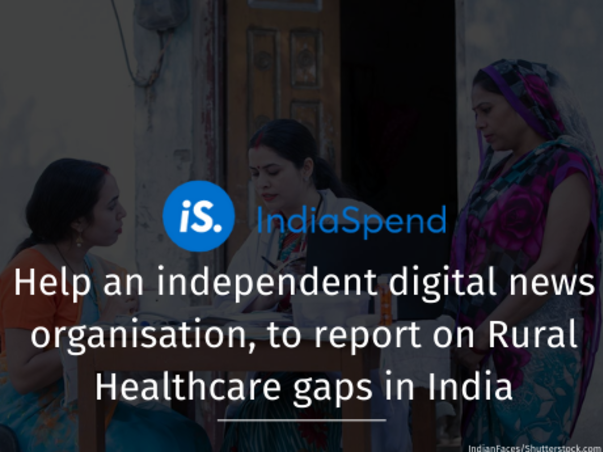
Support IndiaSpend in highlighting the critical gap of healthcare in rural India, by bringing the stories of this underserved population to a larger audience, and to the attention of policymakers.
IndiaSpend is the agency-of-record on data and facts on the Indian economy, particularly in areas such as public health, education, gender, climate change and environment. We utilise open data to inform public understanding on a range of issues, with the aim of fostering better governance and more transparency and accountability in governance, and apply a solutions lens to data journalism.
While the figures are startling in themselves, the problem takes on even grimmer overtones when you consider the disparities from state to state. For instance, Goa has a doctor-patient ratio of 1:380, much better than the national average and even the WHO standard. Against that Nagaland's numbers are 1:17,060. Besides such wide disparities from state to state, there is also a gaping urban-rural divide, with the rural population critically underserved by healthcare professionals.
Support IndiaSpend in highlighting the critical gap of healthcare in rural India, by bringing the stories of this underserved population to a larger audience, and to the attention of policymakers.
IndiaSpend is the agency-of-record on data and facts on the Indian economy, particularly in areas such as public health, education, gender, climate change and environment. We utilise open data to inform public understanding on a range of issues, with the aim of fostering better governance and more transparency and accountability in governance, and apply a solutions lens to data journalism.