

 Share
Share

BRINGING FBTM® SMART CLASSES TO RURAL GOVT SCHOOLS IN SINGRAULI, MP
1. QUICK SUMMARY
- India’s basic school education is in bad shape. In spite of intent, efforts & investments – learning outcomes are actually falling as more and more children in primary schools are struggling with the fundamentals of reading & mathematics. This is essentially putting our ‘demographic dividend’ in danger. Clearly we lack a method to address our school education woes in India.
- And the size of the problem is globally unprecedented – the future of 24 Crore children is at stake, and there’s a shortfall of ~30 Lakh teachers.
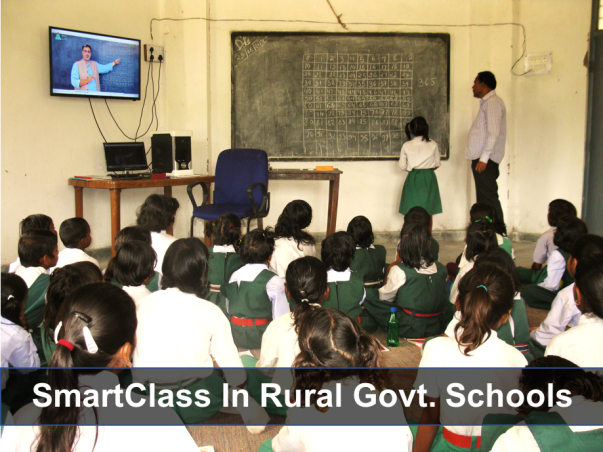
- Bharat Learn believes it has a solution to that can address this problem at this scale – Smart Classes through their Film Based Teaching Methodology® in Rural Govt. Schools. An innovative methodology that integrates Content & Methodology to both, Empower Teachers & Engage Students.
- Bharat Learn has signed an MoU with the Govt. of Madhya Pradesh for their NEEV Program, to set up & run these Smart Classes in 100 Govt. primary schools in one of the most backward districts, Singrauli.
- The pilot for these Smart Classes in 15 schools is underway. Two-year targets have been set for a dramatic improvement in learning outcomes & there’s very encouraging feedback coming.
- Out of the total outlay of Rs. 115 Lakhs, the program has started receiving CSR funding of Rs. 36 Lakhs from PSU giants like NCL & NTPC. The total MOU is for Rs 40 Lakhs. But even this will not help sustain this program beyond November 2017, which is why this crowdfunding campaign is critical. Read on to know more on this wonderful endeavour!

2. BASIC SCHOOL EDUCATION IN INDIA IS IN BAD SHAPE


 The percentage of children in standard five who can do division has declined from 42.5% in 2007 to 26% in 2016 – which means 3 in 4 can’t.
 The percentage of children who can read a standard two text has worsened from 53% in 2006 to 48% in 2016. This means every second Class 5 student in rural India can’t read the text of a class three levels below.
 Only a fourth of students in standard five can read English sentences.
3. WHY SHOULD WE BE CONCERNED
Ruby Rai made headlines last year when she termed political science as prodigal science, and claimed the subject involved cooking. Rai had topped the higher secondary examination in Bihar in 2016. Students like Rai are just the tip of what is probably a giant iceberg comprising poorly educated school students in India. The 2016 Annual Status of Education Report (ASER), which was released recently, vindicates this theory. A look at ASER reports in the last decade punctures the rosy picture vis-à-vis school education, which has been built from increasing enrolment. Here’s why.
The percentage of children in standard five who can do division has declined from 42.5% in 2007 to 26% in 2016 – which means 3 in 4 can’t.The percentage of children who can read a standard two text has worsened from 53% in 2006 to 48% in 2016. This means every second Class 5 student in rural India can’t read the text of a class three levels below.Only a fourth of students in standard five can read English sentences.3. WHY SHOULD WE BE CONCERNED
At a time when the average age of the population in most of the western world is increasing, India has more than 50% population less than 25 years of age. This means that if educated and skilled properly, Indians could provide the labour for the world tomorrow, which can be a huge economic engine for our own country. This is the ‘Demographic Dividend’ that everyone is talking about.
But “how will you reap the demographic dividend when your school children are not learning the basics?” asks Yamini Aiyar, Director of Accountability Initiative, part of think-tank, Centre for Policy Research. She cautions, and rightly so, that if we fail to educate our kids, this ‘Demographic Dividend’ will soon become a demographic disaster of unseen proportions. This is because education define social choices. Poor education is closely correlated with high poverty, crime and with general drop in all social development indicators.

If we live in India, our personal interests and well-being is closely linked to the investment we make into the kind of education we provide not only to our children but to the children of India at large.
4. OF COURSE, A LOT IS BEING DONE!
It is not that the concern is not recognized within India. It is, in fact, a burning issue at every level of government and society and is drawing unprecedented intent, effort and investment.
- The right to education act 2009 (RTE) mandating free and compulsory education for every child between the age of 6 and 14 was the surest evidence of intent that something needs to be done about school education.
- Between 2006 and 2013, public expenditure on school education increased from 2.2% to 2.68% of GDP and continues to increase even now. Besides this, more and more companies are spending their CSR funds on education, many upto 70% of their total CSR budget!
- There are more than twenty thousand NGOs working on the ground in areas of education and literacy.
All this intent, effort and investment has resulted in significant improvements in school infrastructure & other indicators.
 And yet, it is the mismatch between learning outcomes and education spending trends in India that calls for serious action.
The obvious question therefore is – When the intent is there, effort is being made and investment is made available, then why our learning outcomes not improving?
5. A LACK OF 'METHOD'
The obvious and logical conclusion could be that we do not have the method to solve the problem of basic education in India.
 It is estimated that we have to teach around 24 Crore children in India. To put things in perspective, 201 out of 206 countries in the world have population less than 24 Crore. Multiply it with the mind-boggling diversity – geography, socio-economic disparity and the fact that they have to be taught in 20+ different languages – and you have a problem, which no country in the world has ever faced.
Add to it the teachers’ question. If one looks at the ‘supply side’, with an optimal, RTE recommended pupil-teacher ratio of 1:30, around 80 Lakh teachers are needed. Against which we have an estimated 50 Lakh teachers that are available, keeping aside the steep variations in the quality of the teachers & the teaching. And, obviously, that cannot be improved & standardized across the country, overnight.
For a problem of this magnitude, since it is unprecedented in the world, no one has a readymade solution. It is clear that we ourselves will need to develop a method that is designed to solve for this scale. And we need to do this fast!
6. KEY CONSIDERATIONS IN 'METHOD' DESIGN
For any method to be effective in improving teaching-learning outcomes in India, it must recognize and build on following fundamental considerations-
- Teacher centric technology. Going beyond the numbers, we know that in primary education, the children have not reached the age or maturity or even equipped with the tools for self-learning. So, just handing over tablets and smart phones to them, filled with the school curriculum content is not going to do the trick. Teachers are far from expendable; in fact, they need to be integral to the solution. If anything, the method needs to both, empower the teachers & compensate for the deficiencies in their teaching methods through judicious use of technology.
- Engage the children. Repetition is a necessary part of learning. But repetition is also boring and disengages children. The method needs to teach in such a manner that the instructional material is presented in a variety of engaging ways using multiple modalities like videos, activities, games, group tasks, etc. The variety deepens understanding, while keeping the student’s interest alive.
- Draw-in stakeholders to the school. Apart from working with teachers, at the core, the solution needs to integrate well with the various stakeholders at the front end of education delivery, i.e., the community, school management committees, district administration and corporate CSR for monitoring & measuring progress. The method needs to be collaborative and participative by design.
7. BHARAT LEARN HAS THE METHOD
Bharat Learn is an initiative of Prakash Bindu Foundation, a registered trust, which has been operative in education domain for the last four years. Its existence comes from the concern towards surveys pointing out the declining learning outcomes for primary school students in India.
Bharat Learn’s proposed method has three components integral to it.
A core innovation, FBTM® Smart Classes
Bharat Learn is a pioneer of Film Based Teaching Methodology (FBTM®) which uses a unique mix of pedagogy and technology to enhance teaching-learning experience. FBTM® content is tested on the ground in different contexts.
So, what Is FBTM®? It is an innovative approach to content design and classroom delivery. It is a Smart Class methodology designed for rural and semi-urban classrooms that integrates content & methodology to both, empower teachers & engage students.
FBTM® ensures relief in workload for the teachers and make teaching-learning simultaneously more effective. Hence, it finds traction both with teachers and students. The typical FBTM® content module has following five elements-
- Student video
- Teachers video
- Tutorial video
- Practice sheets
- Comics made on video instructions
Also, FBTM® modules follow a 5M design principle which is very unique to Bharat Learn. All FBTM® modules are multi-modal, multi-lingual, modular, motivating, morals & values aligned. Some of the FBTM® Smart Class modules can be seen at www.bharatlearn.org/videos/
Operational Integration
FBTM® Smart Class content, or any other content for that matter, is incomplete if just given to school by itself. Bharat Learn ensures the availability of the following in every school-
- FBTM® content
- A 40” smart TV, a computer and printer
- 600 watt solar power support where schools do not have power
- Teacher training and handholding
- Monitoring software support
- Community engagement
Strategic Model
8. PROJECT NEEV: AN INTEGRATED MODEL FOR FBTM(R) POWERED SMART CLASSES
Bharat Learn works closely with state governments and district administration (through formal memorandum of understandings), which provide the schools for our work and ensure on-the-ground alignment.
The funding for the project, so far, has been brought in through corporate CSR and individual donations.
8. PROJECT NEEV: AN INTEGRATED MODEL FOR FBTM(R) POWERED SMART CLASSES
- NEEV is a program for primary (class I to V) teachers and students to instill strong fundamentals.
- First chosen subject is ‘Mathematics’ - to impact one of the key areas where learning outcomes are weakening alarmingly, as also to counter the phobia about the subject that settles at early levels in the students.
- ~100 modules of Student Videos, Teacher Videos, Practice Sheets and Comics are being made ready.
- All FBTM® content has been created in Hindi – targeting 9 Hindi speaking states that represent 50% of all India population.
- More subjects to be added after initial implementation.


MOU signed with Government of Madhya Pradesh for implementing Project NEEV in 100 schools.

9. PROJECT NEEV @ SINGRAULI: THE EASTERN MOST DISTRICT OF MP

Why Singrauli?
As per Government oF Madhya Pradesh (GoMP) baseline survey of educational outcomes in government schools in 2016, Singrauli is ranked 50th out of 51 districts in MP. Poorest in learning outcomes, Singrauli perhaps needs Project NEEV the most.
The 100 primary schools in Singrauli have been selected with the help and guidance from District Program Coordinator (DPC) & District Education Officer (DEO), and in consultation with funding partners. The selected schools are a mix of tribal, girls and co-ed schools, however the minimum school selection criteria is:
- At least 100 students at primary level
- Availability of a classroom to set-up the smart class
Scope Of The Program – Content
- All content aligned to curriculum of M.P. – ratified by Rajya Shiksha Kendra, the department of school education, Govt. of MP.
- Approximately 100 modules containing Student Videos, Teacher Videos, Practice Sheets and Comic books
- All elements except comic books are made available digitally – preloaded on the computers.
- Printed comic books are made available at schools
Scope Of The Program - Equipment & Infrastructure
Gap analysis done in selected schools to check if these infrastructure elements or their suitable alternatives are available:
- 40” LCD TV or equivalent
- Wi-Fi enabled computer
- Printer
- 600 watt solar support as required
Scope Of The Program: Training & Handholding
- Local office presence of Bharat Learn with 10 trained volunteers/resources.
- Offsite classroom training workshops for all teachers
- Regular visits to schools by BL resources to handhold teachers inside the classroom.
- Quarterly seminars/convention of trained teachers. Establishing measures of success:
- Teacher’s feedback
- Learning outcomes of students
- Baseline test/survey for learning outcomes – existing or fresh
- Periodic students tests to measure progress
- Implementation tracking through the preloaded application on the computer.
- Third party survey/tests
10. PROJECT NEEV @ SINGRAULI: PROGRESS SO FAR
A. Baseline Data Collected: Singrauli Learning Outcomes (2016)




 Pardada Pardadi Education Society (PPES), located in Anoopshehr, Distt. Bulandshehr, U.P., is an organization, which strives to develop rural India through the empowerment of rural girls. Bharat Learn’s Basic Equaliser Course (BEC) is being implemented for their 600 primary level girl students.
 Centre for Equity Studies (CES) run homes for destitute and homeless street children. BL-BEC is being implemented for their 300 children in three Delhi homes of which two are girl homes and one boy home. Implementation is being planned for their Patna and Kolkata homes now.
 I-Saksham Education & Learning Foundation (I-Saksham) is an in-situ delivery of education using digital technology and content by propoerly trained and supported rural youths, skilled as community tutors or school teachers. Implementation is being rolled out for their 1500 students in Munger, Bihar.
 Goonj is a leading organization working in 21 Indian states on issues of clothing and rural empowerment. They also support basic school education through material and systemic support. Implementation is being planned out for their supported centers in Uttarakhand and Bihar.
 Literacy India is focused at imparting basic education to women and children by transforming the education landscape through exposure to a more innovative and non-traditional method of learning. Implementation is being planned out for their centers and supported initiatives in Haryana.
 Further validation - The same pilot modules have been handpicked by Ravi J. Matthai Centre for Education Innovation at IIM, Ahmendabad for a wide ranged study in Govt. schools in Gujarat.
 “FBTM® is a unique and innovative approach unlike any we have seen in the past. The videos are very engaging, effective and easy to understand for students as they are in Hindi. Students have a sense of anticipation and they look forward to the class. Even teachers are finding this very useful”
 “Children are getting attracted to the computer based classes and FBTM® increasing their interest in the subject. It is an easy and effective way to teach. The attendance in the class has increased.”
 “Both, teachers and students are liking FBTM®. It is making teaching easier and more effective. Children are also learning faster through film and the activities showed in the videos.”
11. PROJECT NEEV @ SINGRAULI: WHAT IS NEEDED FOR IMPACT


B. Targets Set For 2018. Project NEEV MP would aim for below mentioned outcomes for the students covered in the selected schools:
C. On 26 July, 2017, 30 teachers and principals from 5 govt schools were taken through an orientation workshop at the Shaskiya Kanya High School, Panjareh, Waidhan, Singrauli. These workshops will follow a monthly cadence. So, in August end, teaching staff of another 5 schools will be initiated at Vindhya Nagar, Waidhan, Singrauli
D. Solar powered FBTM® Smart Classes being installed and commissioned at govt schools in Churki, Karela and Piparkhad villages in Chitrangi block of Singrauli. The 600 Watts solar power will be used to run a smart TV, computer, printer, a fan and couple of LED lights.
E. Teachers’ Training & Demos going on in Singrauli Govt. Schools. Three days teachers’ training and demo classes are held in all the schools to give the teachers initial comfort and confidence to run FBTM® Smart Classes on their own.
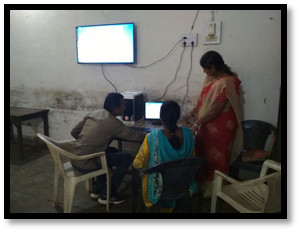
F. FBTM® Smart Classes are getting operational in Singrauli Govt. Schools. Schedule and session plans are finalized in consultation with the teachers and headmaster. Classes are then scheduled and monitored as per the agreed schedule.
G. Why Everyone Believes This Will Work
Tested approach - Pilot testing for the first 20 modules has been done with 5 NGOs in the frontline of education with a reach of about 5000 students across Hindi speaking states.
Pardada Pardadi Education Society (PPES), located in Anoopshehr, Distt. Bulandshehr, U.P., is an organization, which strives to develop rural India through the empowerment of rural girls. Bharat Learn’s Basic Equaliser Course (BEC) is being implemented for their 600 primary level girl students.Centre for Equity Studies (CES) run homes for destitute and homeless street children. BL-BEC is being implemented for their 300 children in three Delhi homes of which two are girl homes and one boy home. Implementation is being planned for their Patna and Kolkata homes now.I-Saksham Education & Learning Foundation (I-Saksham) is an in-situ delivery of education using digital technology and content by propoerly trained and supported rural youths, skilled as community tutors or school teachers. Implementation is being rolled out for their 1500 students in Munger, Bihar.Goonj is a leading organization working in 21 Indian states on issues of clothing and rural empowerment. They also support basic school education through material and systemic support. Implementation is being planned out for their supported centers in Uttarakhand and Bihar.Literacy India is focused at imparting basic education to women and children by transforming the education landscape through exposure to a more innovative and non-traditional method of learning. Implementation is being planned out for their centers and supported initiatives in Haryana.Further validation - The same pilot modules have been handpicked by Ravi J. Matthai Centre for Education Innovation at IIM, Ahmendabad for a wide ranged study in Govt. schools in Gujarat.H. Some voices from the field
“FBTM® is a unique and innovative approach unlike any we have seen in the past. The videos are very engaging, effective and easy to understand for students as they are in Hindi. Students have a sense of anticipation and they look forward to the class. Even teachers are finding this very useful”Ajay Mishra
(APC – Zila Shiksha Kendra, Singrauli)
“Children are getting attracted to the computer based classes and FBTM® increasing their interest in the subject. It is an easy and effective way to teach. The attendance in the class has increased.”Dilip Kumar Verma
(Headmaster, Govt. Girls School, Singrauli)
“Both, teachers and students are liking FBTM®. It is making teaching easier and more effective. Children are also learning faster through film and the activities showed in the videos.”Manvati Vaish
(Teacher, Pri School Panjreh, Singrauli)
11. PROJECT NEEV @ SINGRAULI: WHAT IS NEEDED FOR IMPACT
Funds needed to see this impact in 15 schools, 3000 kids & 75 teachers under current phase of project NEEV are as under:
Of this, the project has started receiving Rs. 36 Lakhs through CSR funding from NCL & NTPC (as per MOUs below)
You can contribute in all of the following ways:
- Make a contribution towards the campaign to help us bring Smart Classes in 15 rural Govt. schools & dramatically improve learning outcomes amongst 3000 primary school kids.
- Start your own support campaign on Milaap to amplify the fundraiser.
- Share this campaign URL on your social media profiles.
Note: INR donations will receive tax exemption under section 80G. All Donors will receive the tax exemption receipts upon completion of the campaign.
If you, as part of a company, are interested to contribute from your CSR funds, please email us to at nitin@bharatlearn.org